
Claude Monet — “Impression, Sunrise”

The Painting at a Glance
Artist: Claude Monet
Year: 1872
Medium: Oil on canvas
Dimensions: 48 × 63 cm (18.9 × 24.8 in)
Created in: Le Havre, France
Current Location: Musée Marmottan Monet, Paris
Movement: Impressionism (and the origin of its name)
When you step into a softly lit gallery and see Claude Monet’s Impression, Sunrise for the first time, it feels less like looking at a harbor and more like witnessing a moment — fleeting, quiet, yet full of light. Painted in 1872, this work doesn’t aim for photographic accuracy; instead, it captures the feeling of a sunrise breaking over the port of Le Havre, Monet’s hometown.
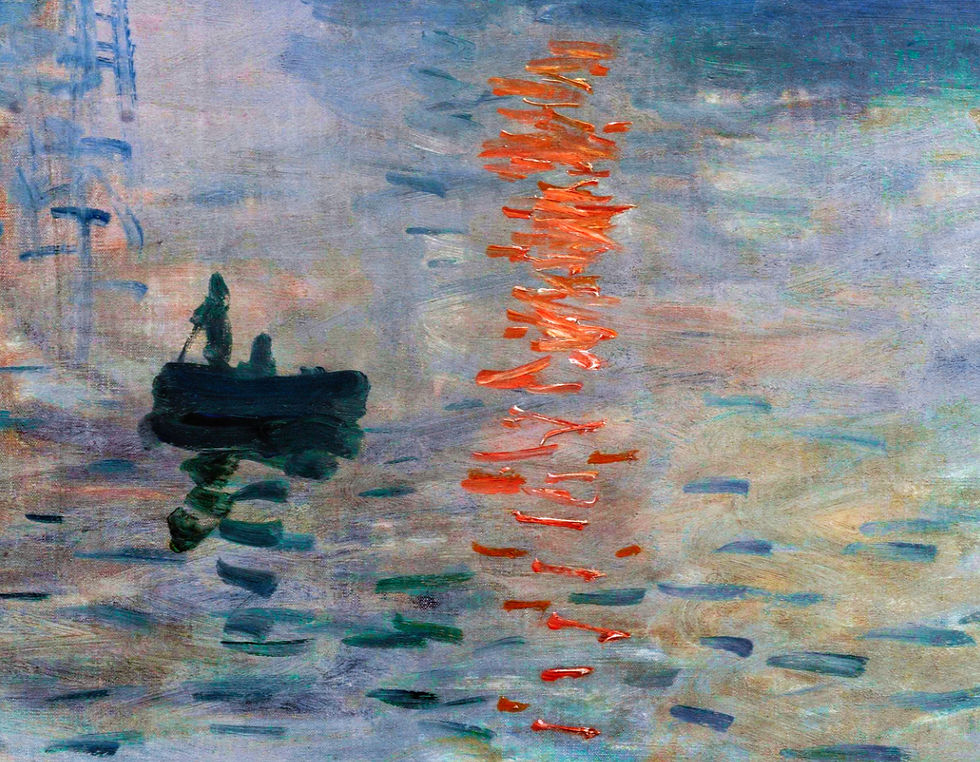
The canvas is alive with loose, visible brushstrokes, a hallmark of Monet’s developing style. Using quick dabs of color rather than blended tones, he lets your eyes do the mixing. The misty blues and grays set the cool morning air, while the small, fiery orange sun pulls you into the stillness of dawn.
A Revolution in a Canvas
When Impression, Sunrise was first exhibited in 1874, it sparked an art-world earthquake. The name “Impressionism” came directly from this painting’s title — originally used mockingly by a critic who found the style unfinished. Monet and his peers embraced the label, proudly wearing it as a badge of rebellion against the rigid, polished realism of the time.
This piece wasn’t just about a harbor. It was about a way of seeing — capturing light, atmosphere, and the poetry of a moment. Monet painted it not to record an exact scene, but to evoke the memory of standing there, watching the day begin.
Techniques That Shaped a Movement
Broken color: Instead of smooth gradients, Monet placed strokes of pure color side by side.
Atmospheric perspective: The hazy layering makes distant ships fade into the mist.
Ephemeral light: Painting “en plein air” (outdoors), Monet worked quickly to trap the shifting colors before they vanished.

Where It Lives Today
Today, Impression, Sunrise resides at the Musée Marmottan Monet in Paris — a must-see for any art lover. Standing in front of it, you’ll notice how small it is compared to its outsized reputation. At just 48 × 63 cm, it’s a modest window into the birth of modern art.
Why It Still Matters
More than 150 years later, the painting’s quiet power hasn’t dimmed. It’s a reminder that sometimes, art isn’t about what you see, but how you see it — a philosophy that changed painting forever.
If this stayed with you…
you can receive one artwork like this each week.


